Edge vs server video analytics: an assessment matrix
Compare edge and server video analytics by tracing compute, network, timestamps, access and human review requirements for the actual existing cameras.
- Author
- aiNOW სარედაქციო გუნდი
- Read time
- 9 min
- Published
In this note
- 01 · What edge and server processing mean
- 02 · Trace compute, network and data
- 03 · Comparison: edge and server placement
- 04 · Check network, timestamps and availability
- 05 · Make the architecture decision explicit
- 06 · What architecture cannot decide
- 07 · Architecture assessment matrix
- 08 · Frequently asked questions
- 09 · Is edge processing always better for existing cameras?
- 10 · Does server processing automatically make video analytics more accurate?
- 11 · Related reading
| Assessment area | Edge-oriented path | Server-oriented path |
|---|---|---|
| Stream movement | More processing can remain near the source | Streams or selected data reach a compute host |
| Local resources | Camera or site device capacity matters | Host capacity and input handling matter |
| Network dependency | Local links still need assessment | Network path can affect delivery and review |
| Operations | Local updates and access need an owner | Host, storage and stream ownership need owners |
TL;DR: Edge and server video analytics move compute and stream handling to different places. Choose by tracing the existing cameras, available compute, network path, timestamps, storage and human review route. Discuss an architecture assessment before selecting a deployment pattern.
What edge and server processing mean
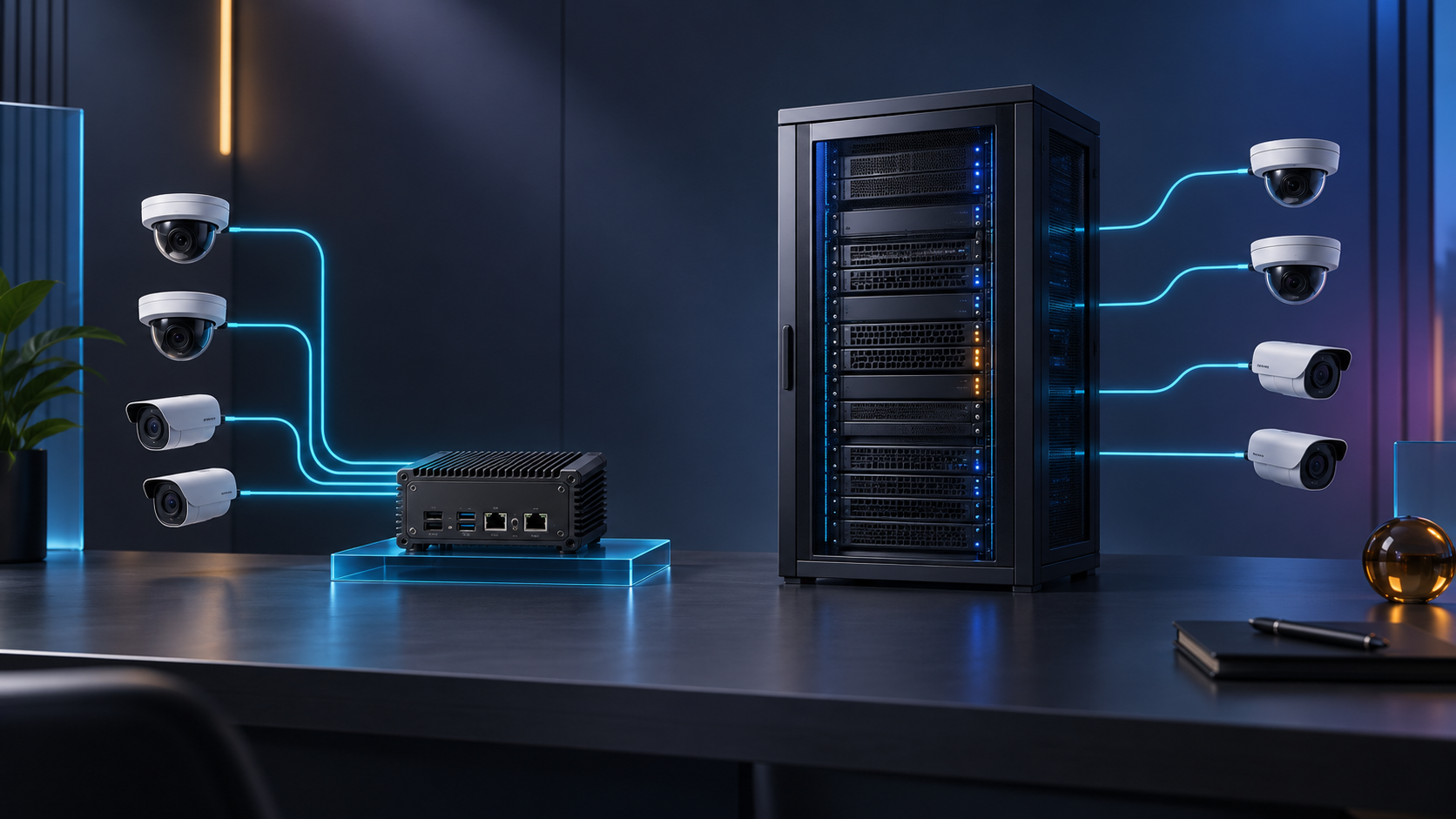
Edge processing keeps some analysis close to the camera or local site. Server processing sends streams or selected data to a separate local or remote compute environment. The labels describe an architecture choice, not proof of a result. A site still needs to know what the camera provides, what the workflow must show and where a reviewer receives context.
NVIDIA DeepStream documents streaming analytics pipelines and multiple input patterns in its technical documentation. That supports asking where streams are decoded and processed. It does not establish an aiVISION architecture or prove that any particular camera set fits either option.
Trace compute, network and data
Start with the actual camera inventory, stream type, network route and available compute. Record whether the local device can receive and process the required stream, whether a server can accept the traffic and what happens when a link is interrupted. Include storage, access and update ownership in the same assessment.
Do not treat a theoretical compute label as a project capacity decision. The workload depends on the scene, stream, number of sources, selected event, review context and operating schedule. A small event rule on a clear view can pose a different question from a broad workflow across warehouses, logistics yards or manufacturing areas.
Comparison: edge and server placement
Both patterns can be suitable in different conditions. The useful comparison follows the path from camera to review and names what remains unknown.
Check network, timestamps and availability
A deployment decision should include the time relationship between camera, processing host, recorder and reviewer. NVIDIA's timestamp documentation discusses synchronization and timestamp handling in stream processing. It is a reference for designing a test, not evidence that the clocks in a customer's environment already align.
Test the path under ordinary and interrupted conditions. Record whether the stream reconnects, whether context reaches the reviewer and whether the archive can be compared with the event record. If a local route is preferred, assess on-premises compute and storage rather than assuming that local placement removes every network or access dependency.
Make the architecture decision explicit
Write the decision as a set of conditions. The site may prefer local processing because of a network boundary, available hardware or a review requirement. It may prefer a server because several camera streams need shared handling or the local device cannot carry the planned workload. These are project reasons, not universal advantages.
A custom monthly service can configure the selected path after assessing the existing cameras, compute, network, storage and review owners. If those inputs are unknown, keep the architecture open and record what test would resolve the uncertainty. Avoid choosing an edge or server label as a substitute for a camera and scene check.
What architecture cannot decide
Edge or server placement cannot prove identity, intent, theft, safety compliance or incident prevention. It cannot recover a blocked view, missing stream or unclear event boundary. The architecture also cannot decide who should respond to a signal. Human review and the site's own operating procedures remain part of the design.
NIST's AI RMF describes governance, measurement, management and clear responsibilities for AI risk work. That supports an explicit owner and monitoring plan, while it is not a certification of an edge or server deployment.
Architecture assessment matrix
- Camera models, streams and scene owners are listed.
- Local and server compute are described as available or unknown.
- Network, reconnect and timestamp behavior are tested.
- Storage, access, update and review responsibilities are named.
- On-premises conditions are assessed separately from preference.
- Decision, unresolved risks and retest conditions are recorded.
Frequently asked questions
Is edge processing always better for existing cameras?
No. It can fit some local constraints, while server processing may fit a different stream, compute or review arrangement. The actual camera and site assessment should decide.
Does server processing automatically make video analytics more accurate?
No. Compute placement does not establish event quality. The view, stream, scene definition, test material and review process still matter.
When choosing placement, also record how the reviewer receives event context and who owns updates. An edge path may depend on local connectivity, while a server path may depend on the host and network owners. Neither label replaces testing the actual stream, timestamp behavior and scene. The decision should remain tied to the conditions available at the site.
Related reading
მასალა მომზადებულია AI-ის დახმარებით და გადამოწმებულია სარედაქციო ეტაპზე.